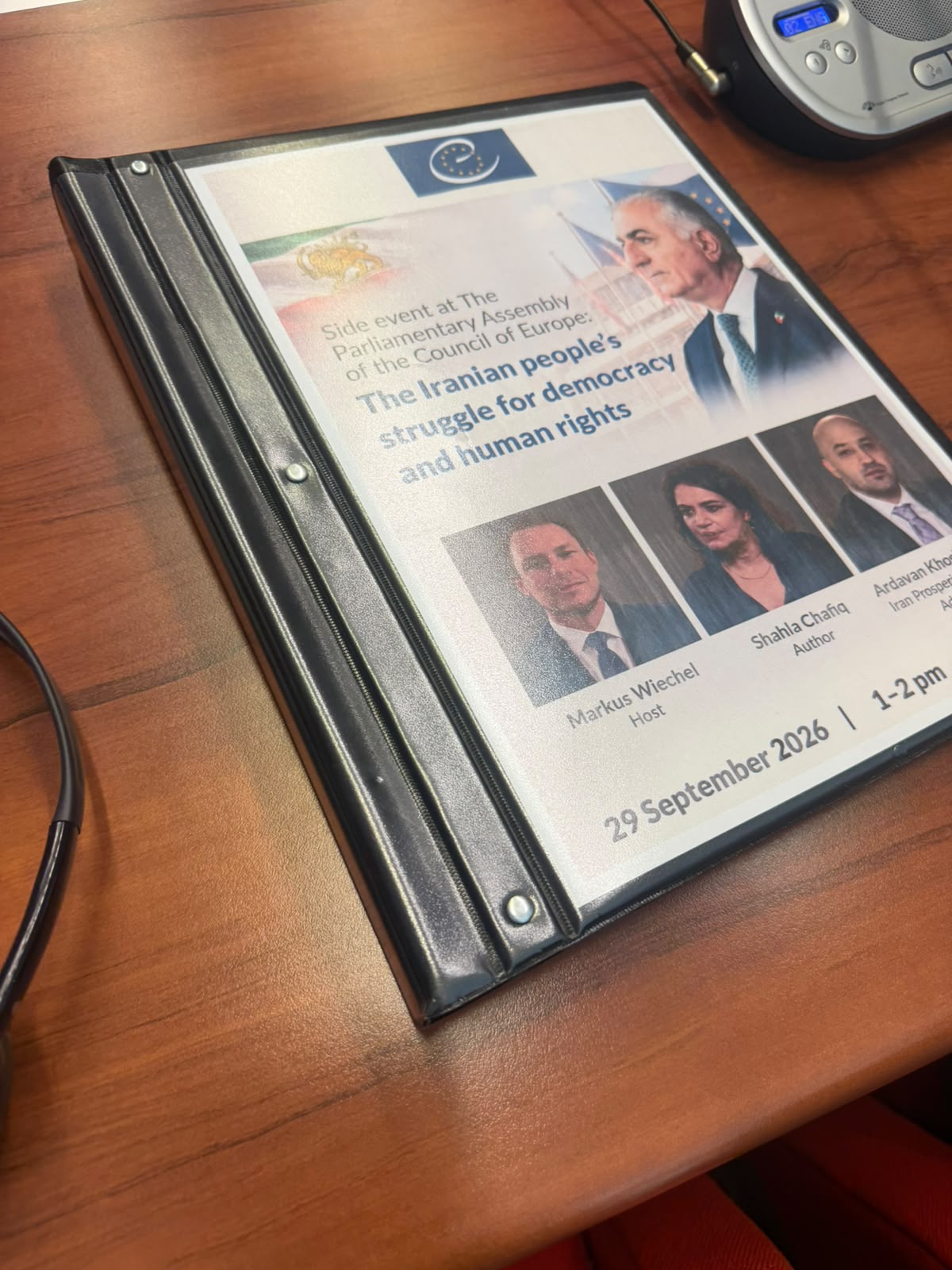
در ۲۹ سپتامبر ۲۰۲۶، بهعنوان یکی از سخنرانان دعوتشده در برنامه The Iranian People's Struggle for Democracy and Human Rights در استراسبورگ شرکت کردم. این نشست در حاشیه اجلاس مجمع پارلمانی شورای اروپا و به میزبانی مارکوس ویخل، نماینده پارلمان سوئد از حزب دموکراتهای سوئد، برگزار شد.
من بهعنوان مشاور پروژه شکوفایی ایران (IPP) در این برنامه حضور داشتم. من و شهلا شفیق، نویسنده و پژوهشگر، دو سخنران دعوتشده این نشست بودیم.
در سخنرانیام بر تأثیر فعالیتهای جمهوری اسلامی بر امنیت اروپا تمرکز کردم و درباره عملیات اطلاعاتی رژیم ایران، تهدید مخالفان و استفاده از شبکههای تبهکاری برای اعمال خشونت در خاک اروپا، بهویژه در سوئد، سخن گفتم.
همچنین پروژه شکوفایی ایران و فعالیتهایی را معرفی کردم که به ابتکار شاهزاده رضا پهلوی برای آمادگی دوران گذار پس از جمهوری اسلامی انجام میشود. بر ضرورت برنامهریزی عملی برای امنیت، تداوم خدمات عمومی و گذار دموکراتیکی که در آن مردم ایران خود درباره آینده سیاسی کشور تصمیم بگیرند تأکید کردم.
پس از سخنرانی، در جلسه پرسش و پاسخ با حاضران شرکت کردم.
متن کامل سخنرانی
متن اصلی به زبان انگلیسی – استراسبورگ، ۲۹ سپتامبر ۲۰۲۶
Your Excellencies, ladies and gentlemen
Thank you for having me here today, and Thank you, Mr Wiechel, for this event and for having us.
I want to speak about Iran. But perhaps more importantly, I want to speak about Europe.
Because there is one thing that forty-seven years of the Islamic Republic should have taught us:
What happens in Iran does not stay in Iran.
The first victims, of course, have always been Iranians: executions, imprisonment, torture, political repression.
But today, I want to focus on what the Islamic Republic does here.
In Europe.
Iranian intelligence services conduct espionage in Europe. They threaten dissidents. They have plotted lethal attacks. And increasingly, they use criminals and criminal networks to do their work for them.
In my own country, Sweden, our Security Service has established that the Iranian regime uses criminal networks to carry out violence on Swedish territory, and has dealt with several concrete attack plots linked to Iranian security services.
Britain's MI5 has said that it tracked more than twenty potentially lethal Iran-backed plots in a single year.
In Germany and France, investigations have likewise described Iranian services using criminal intermediaries to surveil and target Jewish and Israeli individuals, businesses and institutions.
This is what the Islamic Republic's transnational repression looks like today.
No longer does it need to send its own officers.
It can recruit a criminal.
It can recruit a gang.
It can recruit a teenager.
And it can do so on European soil.
The methods the regime uses to intimidate and control people at home do not stop at Iran’s borders. And as we have seen, those same methods are also used abroad, against people and institutions in Europe.
What happens in Iran does not stay in Iran.
The Islamic Republic’s campaign of intimidation and violence in Europe did not, however, begin yesterday. The record stretches back decades.
Paris. Berlin. Stockholm. London. The Hague.
The geography matters. These are European cities, not Iranian ones. And the regime’s reach is not limited to intelligence operations and violence on European streets. Its military support for Russia’s war against Ukraine is one example.
So, when someone asks why developments inside Iran should matter to Europe, the answer is simple.
Europe is already affected — through intelligence operations, criminal proxies, violence on European soil, and military support for Russia’s war against Ukraine.
What happens in Iran does not stay in Iran.
Now, many of you in this room — and many decision-makers across Europe — quite correctly ask another question:
But what happens if the Islamic Republic falls?
Who is ready for the day after?
Well, for almost five decades, Crown Prince Reza Pahlavi has argued that Iran's final political system must be decided by the Iranian people.
Not by him.
Not by a foreign government.
By Iranians, through the ballot box.
But there is a difference between opposing a regime and being prepared for what comes next.
Slogans are not enough. A transition needs a plan.
And that is where the Iran Prosperity Project comes in.
Under the Crown Prince’s initiative, more than seventy Iranian experts from inside Iran and the diaspora have worked on a detailed roadmap for the period after the Islamic Republic. Its Emergency Phase is specifically designed for the first six months of a transition.
It asks the practical questions that must be answered before that day arrives:
How do we keep the lights on?
How do hospitals continue to function?
And how do we move political power, to the ballot box?
These questions must be answered before a transition, not after it. And that is precisely what the Crown Prince and the Iran Prosperity Project are working to do.
So, to answer the question directly: when the Islamic Republic falls, there is a plan for the transition that follows. And you asked: who is ready for the day after?
The Crown Prince is.
We in the Iran Prosperity Project are.
And perhaps most importantly, the Iranian people are.
Another future can be built for Iran. And, although Iran's political future belongs to Iranians, Europe has a direct stake in that future.
An Iran whose security services do not plot violence on European streets.
An Iran that does not recruit European criminals.
An Iran that does not support a war against a European country.
So I will end where I began.
What happens in Iran does not stay in Iran.
That has been true for forty-seven years.
And it will also be true of what comes next.
Thank you.