Conference abstract
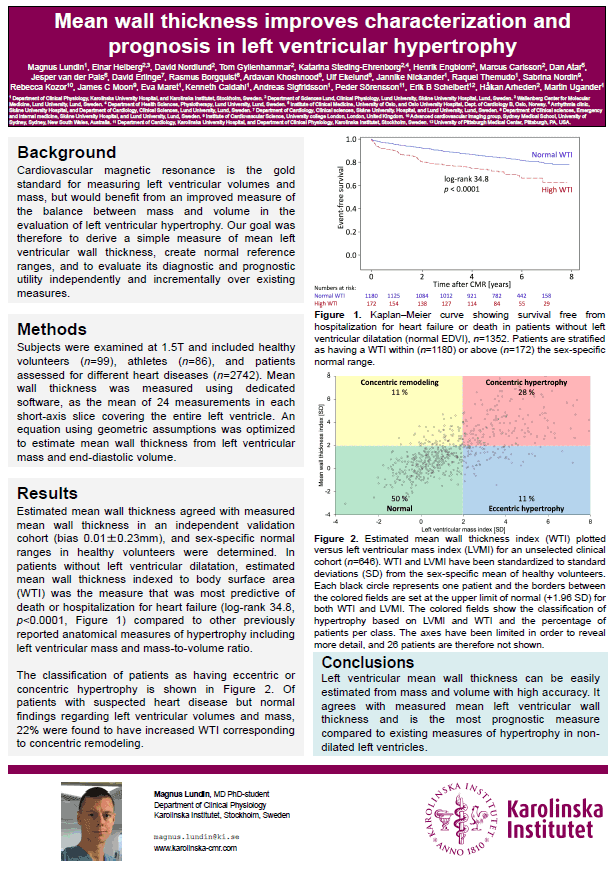
Left ventricular global wall thickness is easily calculated, detects and characterizes hypertrophy, and has prognostic utility
20th Cardiovascular Spring Meeting
- Organizer:
- Location:
- Date:
- 10 – 12 April 2019
Abstract
Background Cardiovascular magnetic resonance (CMR) can be used to measure left ventricular end-diastolic volume (LVEDV) and left ventricular mass (LVM). However, there is currently no good way to measure the normality of LVM in relation to a given LVEDV. We hypothesized that a simple measure of left ventricular global wall thickness (GWT) would be accurate, beneficial for detecting and characterizing hypertrophy, and have prognostic significance. Methods Subjects underwent CMR at 1.5T, including healthy volunteers (n=99) and patients assessed for heart disease (n=2828). Results GWT calculated from LVEDV and LVM had excellent agreement with measured mean end-diastolic wall thickness of the entire left ventricle (bias 0.01±0.23mm). GWT was most predictive of death or hospitalization for heart failure in patients with normal findings by CMR (n=326, log-rank 26.8, p Conclusions Left ventricular GWT is an intuitive measure that can be easily calculated from mass and volume with high accuracy, and has prognostic utility in patients with normal CMR findings. Also, GWTi classifies hypertrophy as concentric or eccentric, and detects concentric remodeling in a substantial portion of patients with otherwise normal findings.