The conflict between Iran and the USA does not date back to the Islamic Revolution in 1979 as many believe. Iran and the USA have been in conflict with each other ever since the 70s when the Shah of Iran, Mohammad Reza Pahlavi, both dramatically raised oil prices [1], and when his foreign policy came to contrast with the interests of the Western world [2,3,4]. Historian Roham Alvandi at the London School of Economics points out that the current Islamic regime in Iran has the same foreign policy goals as the Shah had, dominion over the Middle East, but that the latter used diplomacy and logic which secured Iran's dominance in the area. We can, however, say with certainty that the current regime in Iran has not only failed to become the Middle East's "policeman," as the Shah was called, but they have also contributed to the region today being one of the most turbulent areas in the world.
Never, however, has the conflict between Iran and the USA been as serious as it is now. Focusing on recent events, what actually happened? It all started on December 27 when Kata’ib Hezbollah, an Iran-backed Shiite militia in Iraq, fired more than 30 rockets at a military base in Kirkuk, killing one civilian American personnel. The USA responded by bombing important targets belonging to Kata’ib Hezbollah in both Iraq and Syria, and dozens of militiamen died. In revenge, Kata’ib Hezbollah attacked the US embassy in Baghdad on December 29. Present at the attack were, among others, Abu Mahdi al-Muhandis – Secretary General of Kata’ib Hezbollah – and Qais Khazali – leader of the Iran-backed Shiite militia Asa’ib Ahl al-Haq.
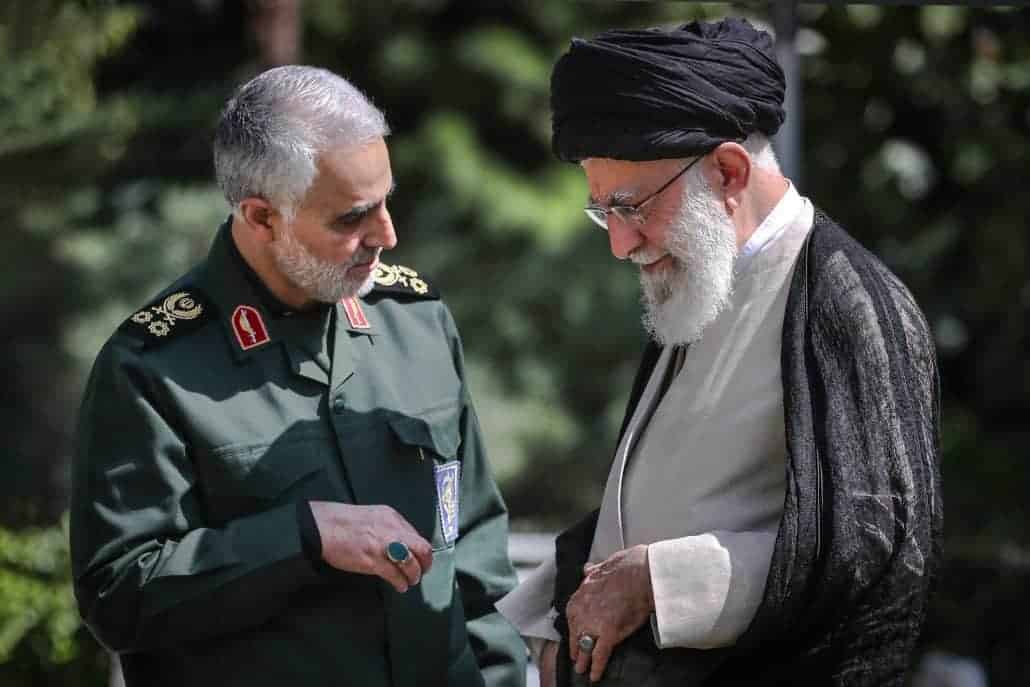
In response to the embassy attack, Donald Trump ordered an attack on the Iranian general, Qasem Soleimani, who at the time led the Quds Force, the foreign branch of the Islamic Revolutionary Guard Corps responsible for intelligence gathering, espionage, destabilization, and terrorism. On Friday, January 3, two cars at Baghdad airport were fired upon by an American drone. Ten people were killed. Among them were Qasem Soleimani and the aforementioned al-Muhandis. Iran immediately threatened severe revenge. Five days later, the revenge came. Close to 20 ballistic missiles were fired mainly at the Ein Al-Asad military base west of Baghdad. The Islamic Revolutionary Guard Corps' aerospace force claimed responsibility.
Shortly after the attack, the regime's foreign minister wrote on Twitter that with the attacks, Iran had only defended itself. He further wrote that Iran was not seeking either escalation or war. Donald Trump in turn wrote that "all is well". According to international reports, no one was injured or lost their life in the attacks, which actually makes Iran's attack probably the best thing that could have happened.
Given that no Americans were injured or died, the USA refrains from attacking various targets in Iran as they had threatened to do. Thus, no war. At the same time, Iran has now had its "revenge." Both countries are therefore satisfied; the USA gets rid of Soleimani, who has been a major contributor to the destabilization of the Middle East, and Iran fires rockets at buildings and structures that are empty of soldiers and gets its revenge. Therefore, we can say with certainty that the escalation we have seen between Iran and the USA since the latter left the nuclear deal in 2018, has now been neutralized. We will now witness a de-escalation and a return to the status quo.
However, this is not how it is mentioned in Iran. In Iran, media report that at least 80 American soldiers were killed in the attacks on Ein Al-Asad, that the revenge was as severe as it could be, and that the USA has now backed down. The fact is, however, if Iran's ballistic missile attacks late at night on January 8 were not highly calculated so that no one would be harmed. In that way, Iran guarantees that the USA does not attack the country, while the attacks domestically can be used as propaganda that the regime actually took its revenge against the great satan, as the USA is called. Thus, the regime saves face nationally and internationally among its supporters.
That Iran and the USA are now returning to the status quo does not mean in any way that the USA will return to the nuclear deal or that the regime in Iran will put aside its malignant activities in the region, Europe, or America. The USA will continue its sanctions against Iran. What we can now expect from Iran is that the regime will become even more aggressive in its behavior, not least now that the country's supreme leader, Ali Khamenei, has announced that nearly 200 million euros will be allocated to the Quds Force. We can expect an escalation of various attacks against American targets in West Asia. More foreigners traveling to Iran will be arrested and accused of being spies for both Israeli Mossad and American CIA. Destabilization efforts will be expanded in the form of Iranian proxy militias receiving even more financial and logistical support, including intelligence and access to advanced weapons. Kidnapping of foreigners in Iraq by these proxy militias is another scenario.
Sweden is also affected by this conflict. The Swedish Armed Forces have personnel on site in Iraq who may be affected by Iranian proxy militias. Furthermore, Sweden has a large exiled Iranian community that fights against the regime in Iran, which will undoubtedly be even more affected by Iran's upcoming aggressiveness. Iran and Iraq may be more than 3000 km from Sweden, but the conflicts taking place there and the key figures in the area, affect Sweden to a very high degree.
On December 20, the Swedish Security Service announced that a person had been sentenced in Stockholm to prison for gross unlawful intelligence activities against a person, i.e., refugee espionage. The person in question is a Swedish citizen of Iraqi origin. He is a Shiite Muslim and has for a long time spied on exiled Iranians in Sweden and other European countries on behalf of Iran. According to the Security Service's preliminary investigation, this person has also been in contact with the aforementioned Qais Khazali.
Status quo has now emerged between Iran and the USA. If Iran does not attack Americans and if Donald Trump uses a more de-escalatory tone, the next milestone in this conflict will be in November when the USA goes to election.
Ardavan Khoshnood
Criminologist
[1] https://www.amazon.com/Oil-Kings-Arabia-Changed-Balance/dp/1439155186
[2] http://dx.doi.org/10.1080/00210862.2014.880631
[3] http://dx.doi.org/10.1080/00210862.2014.880629
[4] https://www.amazon.com/Age-Aryamehr-Pahlavi-Global-Entanglements/dp/1909942189/