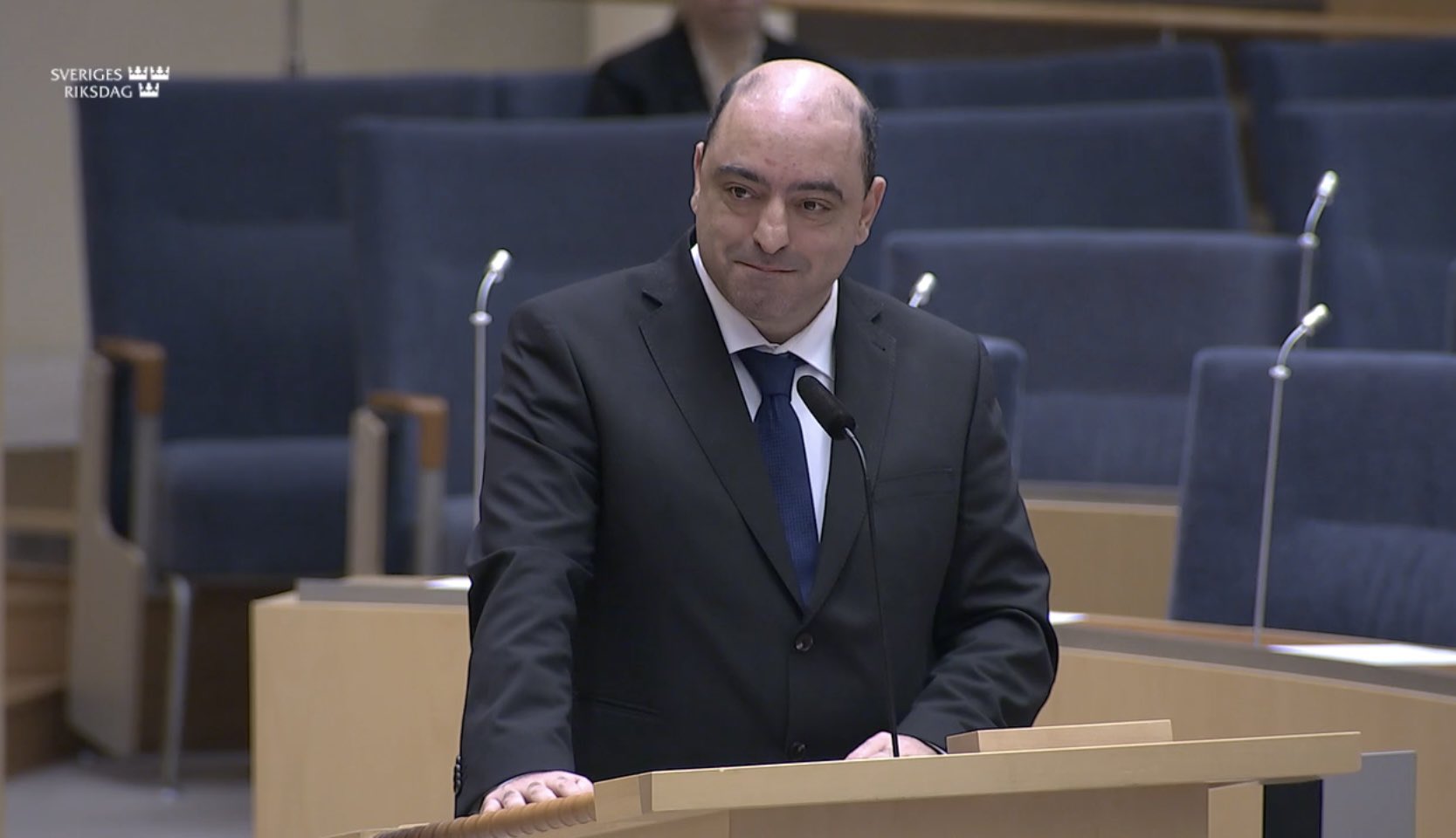
As Nima Gholam Ali Pour’s four years in the Swedish Parliament now draw to a close, there is reason to pause and look at what he has actually done.
The numbers tell part of the story. During the term, the Riksdag records 85 motions, 50 written questions, participation in 66 interpellation debates, 21 debates on committee proposals, 25 question times, and four foreign policy debates. At the same time, he has been a full member of the Committee on Social Insurance since the autumn of 2022 and a deputy member of the Committee on the Labour Market since 2023.
But the numbers do not tell the whole story.
Anyone who has followed Nima during these four years knows that he has worked on far more than a single issue. Migration and integration, social insurance, Islamism and foreign influence, the labour market, education, Taiwan, and other foreign policy matters have all recurred in his work. He has used the tools actually available to a Member of Parliament – motions, questions, interpellations, and chamber debates – to pursue issues he has regarded as important for Sweden.
And then there is Iran.
For those of us with roots in Iran, it has been difficult not to notice the place this issue has had in Nima’s parliamentary work. Time and again, he has raised political executions, the repression of opposition figures, democracy assistance, Swedish technology that risks ending up in the regime’s hands, relations with the Iranian opposition, and the activities of the Islamic Republic in Sweden. In August 2025, through an interpellation, he directly raised the question of a Swedish dialogue with the Iranian opposition and explicitly mentioned Reza Pahlavi.
At the same time, it is important to understand that this has not only been about Iran.
Nima has consistently linked the Iran issue to Sweden’s own security. That connection is also reflected in the assessments of the Swedish Security Service. Säpo has stated that the Iranian regime has conducted security-threatening activities in and against Sweden, mapped opposition figures, and used criminal networks as proxies for acts of violence in Sweden. Iran, together with Russia and China, has been identified as one of the major state security threats to Sweden.
It is against that background that Nima’s questions about foreign state influence, organisations linked to the regime, possible ties between mosques and foreign powers, and the need for better tools against foreign influence should also be understood. In Parliament, he has explicitly argued that what the Iranian regime does to Iranians cannot be separated from what the same regime does on Swedish soil.
One of the clearest moments came in the spring of 2026.
At the beginning of March, Nima Gholam Ali Pour and two other Members of Parliament sent a formal invitation to Crown Prince Reza Pahlavi to visit the Swedish Parliament. On 13 April, the visit became a reality. The Crown Prince came to Stockholm and spoke in the Swedish Parliament before Swedish parliamentarians about Iran, democracy, and the relationship between developments in Iran and European security.
For me, this is an important part of Nima’s four years.
He has been able to bring his experience and knowledge of Iran into the Swedish Parliament without treating Iran as an issue separate from Sweden. On the contrary, his recurring premise has been that a foreign power that conducts intelligence activities, uses criminal networks, and threatens people on Swedish soil is also a Swedish concern. Standing up to that kind of activity is therefore both a matter of solidarity with people in Iran and of defending Sweden’s security and democratic institutions.
You do not have to share every position a Member of Parliament has taken to recognise the scale of the work. 85 motions. 50 written questions. 66 interpellation debates. Four years of committee work, chamber debates, and political initiatives. And throughout it all, a persistent effort to make Sweden understand what the Islamic Republic is, what it does to its own people, and why its actions also affect Sweden.
Nima is now leaving Parliament. But these four years are already part of his political record.
Thank you, Nima, for the work. For using your seat. For giving Iran a voice in the Swedish Parliament – and for never losing sight of why you were there: for Sweden.